Starting an Artificial Intelligence newsletter in 2026 is mostly about finding an idea using a simple way to publish it and sending it out regularly with a template that you use every time. A good Artificial Intelligence newsletter usually does well because it is one thing, for one group of people and it makes one promise. It also helps to have a structure that’s easy to follow so readers can quickly look through the Artificial Intelligence newsletter.
A big mistake people make is trying to write about every thing that happens with Artificial Intelligence. This gets really confusing and hard to understand. It is better to focus on one group of people and what you want to happen for them. For example you could write about Artificial Intelligence for people who do marketing or Artificial Intelligence for people who start companies or how Artificial Intelligence can help people who use Excel for their work. Then you make sure every single issue you write is helpful to that group of people, like the marketers or the founders or the Excel users.
Some good ideas for topics, in 2026 are things that people really want to know about. Topics that work well in 2026 include
The good topic angles that work well in 2026 are ones that people can relate to. Good topic angles that work well in 2026 are also things that’re interesting to read about.
Our newsletter is, like a briefing. It has news and what it means. We tell you what changed why you should care and what you should do about it.
Workflow newsletter: “copy-this” automations and step-by-step setups.
Tool scout newsletter: one tool review per issue + use cases + limitations.
Role-based newsletter: AI for HR, finance, sales, teachers, designers, etc.
Local/regional newsletter: AI updates and opportunities for a specific market (e.g., India SMEs, Delhi startups).
Here are the tools you will need for a stack
The simple stack tools are pretty easy to get
You will also need a stack to practice on
The simple stack is a good place to start learning
When you are choosing tools for writing and managing lists and looking at analytics you should pick the ones that make these tasks easy to do. Then you should try not to switch to platforms for at least 90 days.
Many email marketing tools focus on things, like separating your email list into smaller groups looking at analytics connecting with other tools and using templates. The reason they focus on these things is that they are what help you be consistent and do better over time.
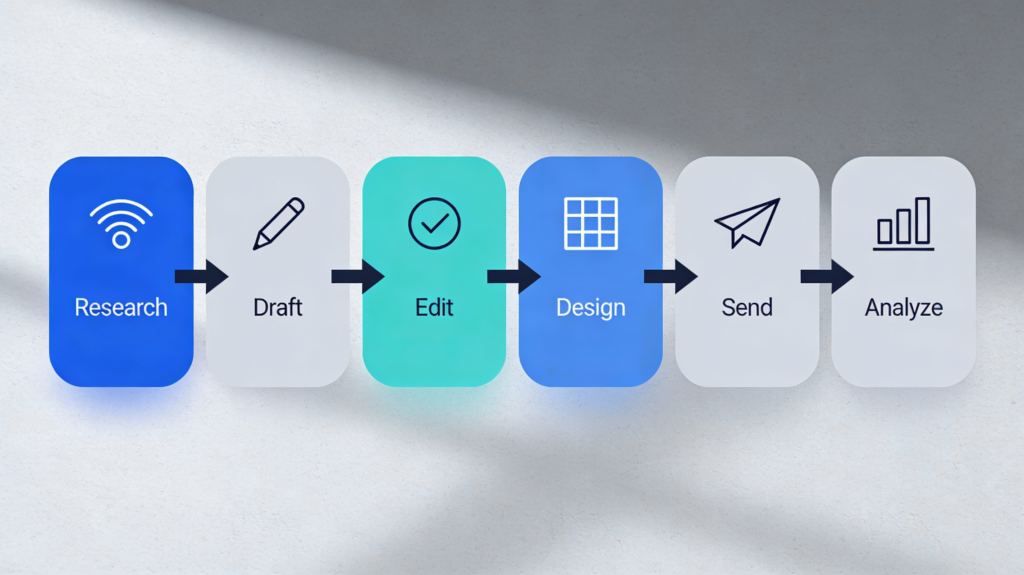
Writing + planning: Google Docs/Notion (drafts, backlog, checklists).
Research: RSS + a reading queue (avoid doom-scrolling).
When you are looking for a newsletter platform you need to choose one that supports forms. This platform should also have segmentation.. It should have analytics. You want a newsletter platform that has all these things so you can manage your newsletters easily. The newsletter platform you choose should be able to help you with forms it should be able to help you with segmentation and it should be able to help you with analytics.
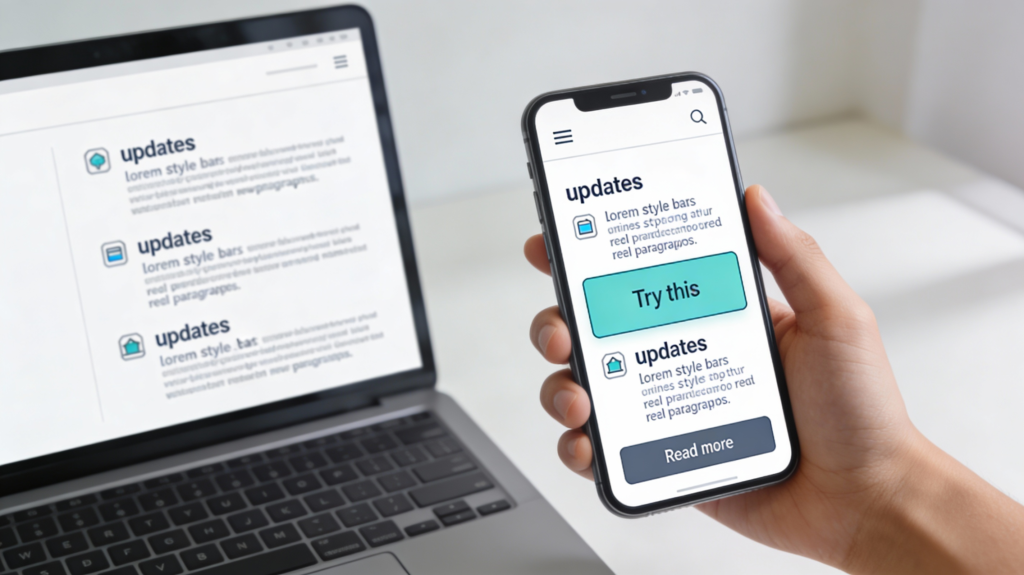
When it comes to the design I think it is an idea to use a clean template. This template should have a lot of whitespace. The layout should also be mobile-friendly. The reason for this is that most people read things on their phones. They tend to skim through the content on their screens.
The design of the template is very important because people will be reading it on their phones. Design is really, about making the template clean and easy to read on phones.
Automation is really useful for things like scheduling email sends and welcome emails. It also helps with tasks such as tagging and making segments for the emails that are sent. Automation does a lot of work, for schedule sends welcome emails and simple tagging and segments.
We should think about what people like to talk about and what they like to read about. Then we can publish those kinds of things. The goal is to keep readers in what we are publishing. We want people to keep coming to our website to read more, about the topics that keep readers.
Newsletters do well when they think about what the reader wants. They should not just talk about themselves. It is an idea to use headlines that are easy to understand. Newsletters should also tell the reader what to do. This can be something like asking the reader to reply with a question. The people who give advice on email marketing for 2026 say that doing these things is very important. They say this over and over again. Newsletters stay healthy when they prioritize reader value over self-promotion and use headlines and include direct calls to action, like “reply with your question”.
Things that are good to talk about and switch between:
Week’s must-know updates (3–5 items max).
One practical tutorial (a prompt, workflow, or mini playbook).
Tool of the week is something that we want to talk about. This tool is for people who need to do a job. It is not for everyone those who do not need to do this kind of work. To get started with the tool you can set it up quickly and easily.
The tool is for people who want to accomplish a task. The tool is not for people who do not have to do this task. Setting up the tool is very simple and fast. You can start using the tool away.
Here are some key points about the tool of the week:
Let me tell you about a case study. This is a story about how a team was able to save time and money. They also improved the quality of what they were doing.
The team in this case study found a way to work smarter. They were able to get things done faster and cheaper. At the time the quality of their work got better.
This case study is an example of how a team can make a big difference. The team, in the case study was able to save time and money. They were also able to improve quality. This is what happened in the case study.
Prompt pack (5 prompts around one job task).
Reader Q&A (use replies as your content engine).
Templates (copy-paste)
To solve problems it is a good idea to use one main template for about 80 percent of the issues that you come across. This approach helps you stay fast and consistent when you are working on things. Using one template for 80 percent of issues really makes a big difference. It helps you get things done quickly. You do things the same way every time, which is very important, for 80 percent of issues.
Template A: “3 updates + 1 action”
Subject: “[Week] 3 AI updates + 1 thing to try today”
This issue is here to help the reader learn something this week. It will guide the reader to understand what they need to do.
Update 1: First we have the headline. Then we get a summary that’s two sentences long. The reason Google News is important is that it shows us what is happening now.
Update 2: Same structure.
Update 3: Same structure.
Try this today: One workflow/prompt with steps (5 lines max).
Tell us about your role and one thing you want to do.
This mirrors the clear, scannable structure many successful AI newsletters use: quick items, context, and practical takeaways.
Template B: “Workflow issue”
Subject: “Copy this: [workflow name] (10 minutes)”
Problem: 2–3 sentences describing the pain point.
Workflow steps: 5–7 bullets.
Prompt: One copy-paste prompt block.
Quality checklist: 3 bullets (“check facts,” “check tone,” “remove sensitive data”).
CTA: “Want a version for your industry? Reply with: industry + tool stack.”
Template C: “Tool review issue”
Subject: “Tool test: [Tool] — worth it?”
Best for: 3 bullets.
Not for: 3 bullets.
How to start: 5 steps.
My verdict: 2–3 sentences.
If you want some help reply with the word “tool”. Tell me what you are using it for. I will do my best to suggest some tools that you can use instead of the tool you are currently using.
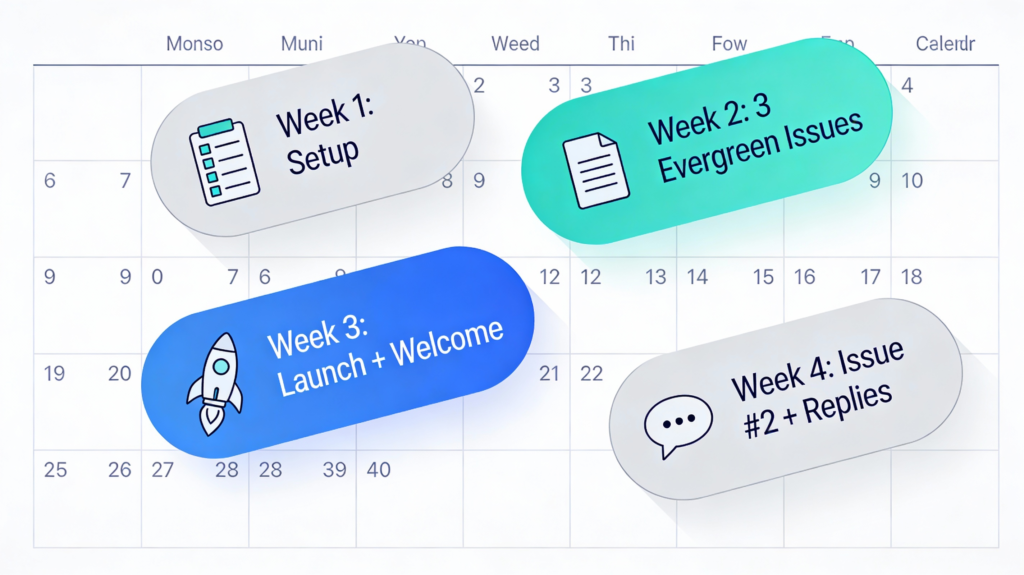
A regular routine is better than a plan. Start by sending one message every week for 8 to 12 weeks. Make sure each message is short so you can finish it on a very busy week. Building a connection, with people who read your messages usually happens when you send messages regularly make it clear what you want them to do and pay attention to things like how many people open your messages and click on links.
Suggested plan:
Week 1: Define audience + promise + name + signup page.
Week 2: Write down three issues that’re always relevant so you will never have to rush to come up with something.
Week 3: Launch with Issue #1 + a simple welcome email.
Week 4: Publish Issue #2 + ask one question to drive replies.
Quality and trust (important in 2026)
When you are working on something it is an idea to be open about what you are doing especially when it is necessary. You should also make sure that what you say is true and not exaggerated especially when it comes to Artificial Intelligence.
For example when it comes to email marketing people are already thinking about what they will do in 2026. The main idea is to be careful, about how you use Artificial Intelligence and to make sure that people trust you especially since Artificial Intelligence is becoming a part of everything.
Practical trust rules:
Do not promise results that you’re unable to prove.
Link to original sources when citing news.
Add a “How this was made” line if your audience values disclosure